Cheap used EVs have doubled, and almost half have barely been used
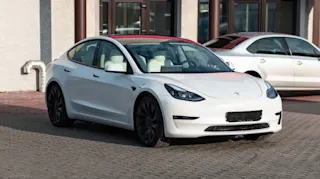
An electric car under $35,000 used to be hard to find. Now it's a quarter of the used EV market, and almost half of them are dealer demos, not second-hand cars.

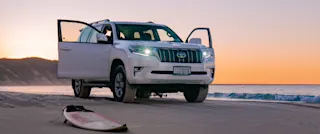
Most people treat last year’s model as the bargain. In August and September 2026, a year-old Toyota LandCruiser Prado was priced within about $700 of a new one, drive-away, a saving of under 1%, and the LandCruiser wagon under 3%. Here’s how much a year-old car really saves, which models it’s a real saving on, and why to compare drive-away with drive-away.
Like for like, a year-old car typically saves you $7,399, or 14.8%, compared with buying new. That means comparing the same model, engine and equipment, rather than a base model with a top-of-the-range version. The figure is based on 70 models with enough year-old cars to make a reliable comparison. It’s a useful benchmark when deciding whether a used car is genuinely good value.
That 14.8% is the middle of a range. Among the popular models in the chart, it runs from nearly a fifth on a Subaru Crosstrek down to almost nothing on a LandCruiser Prado.
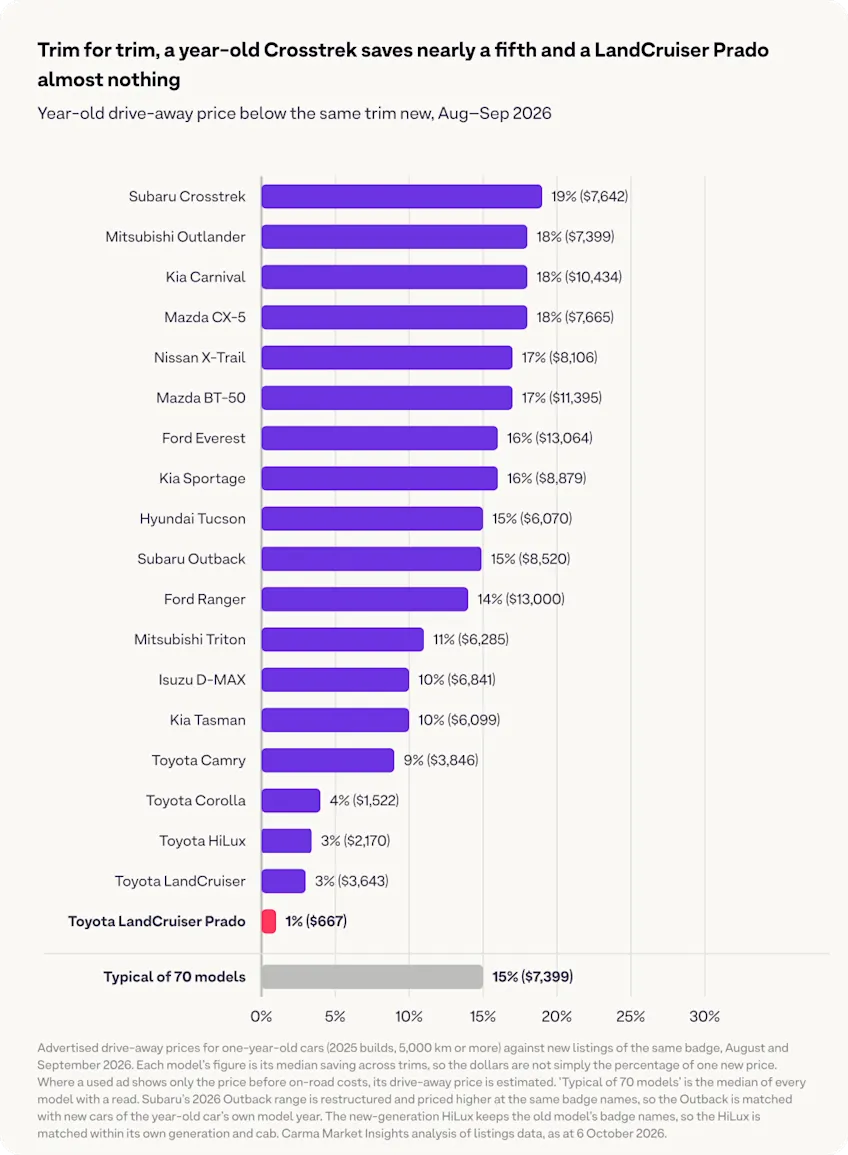
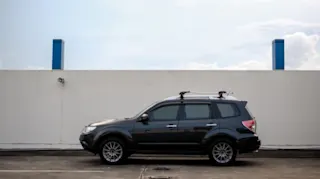
The biggest percentage saving among the popular models in the chart is on a small SUV. A year-old Subaru Crosstrek was $7,642 under the equivalent new one, 19.4% of its drive-away price. The Mitsubishi Outlander and Kia Carnival were both at about 18%.
Both new and year-old Outlanders have fallen in price. In the three months to September, new Outlanders were advertised at around list price, down from 5% above list price a year earlier. It was also reported that Mitsubishi carved out $10,000 from the plug-in hybrid to help remain competitive with Chinese brands. A year-old Outlander was listed at 83% of its list price, down from 94% a year earlier, and took an average of 71 days to sell, up from 48.
On a $40,000 family SUV, buying a year-old version can save you $7,000 to $8,000. It’s the kind of saving many buyers expect from a nearly new car, and on some family SUVs, it’s real.
Toyota is where that picture starts to break down, particularly with its four-wheel drives. Across the Toyota models we compared, year-old cars were typically priced just 4.2% below their new equivalents. A year-old Corolla, for example, was $1,522 cheaper than a new one.
On the Prado the saving is $667, under 1% of the new car's drive-away price. On the LandCruiser wagon it's $3,643, under 3%.
At LandCruiser prices, on-road costs make a big difference to the comparison. The NRMA says these can add more than $7,000 to the cost of a new car, before accounting for luxury car tax on a vehicle at this price. Used cars are usually advertised before on-road costs, so comparing that price with a new car’s drive-away price overstates the saving.
The short answer is that a new one is hard to get. Toyota says it can't get enough cars. "Supply is the main reason why we are down," Toyota's John Pappas told WhichCar this year. He put the wait for a new Toyota at three to six months.
The Prado has been tight since the current model arrived. Toyota gave dealers a fixed 12-month allocation of Prados rather than an open order list, CarsGuide reported. Once a dealer's allocation was gone, a new buyer could only register interest.
And in August, Drive reported that the Japanese factory that builds the Prado had stopped production after an earthquake.
So a year-old Prado on a car yard is a Prado you can drive home today. Buyers pay close to the new price for that, and sellers know it.
New-car prices have also risen, helping to support used values. In early 2026, Toyota added $700 to every Prado and $1,000 to every LandCruiser 300, the first price rises for either range since 2024, CarExpert reported.
Meanwhile, used Prados aren’t in short supply. In August and September, 370 year-old Prados came off the market, nearly four times the 94 recorded over the same period a year earlier. The shortage is on the new-car side, not the used market.
Those savings didn't hold still over the year either. On the 42 models we could compare in both years, a year-old car saves a typical 15.2% this year, up from 13.5% in August and September 2025.
Most of that growth came from the utes and the Kia Carnival. Family SUVs barely moved. A year-old Carnival now saves 17.7%, up from 9.3% a year ago, and a Mazda BT-50 ute saves 16.5%, up from 11.2%.
The Carnival’s bigger saving comes from the used-car price falling. A year ago, a year-old Carnival was listed close to its full list price, a legacy of the long wait times for new cars. It now sits at 89% of list price, with more available for sale (104, up from 65), while the new-car price remains unchanged. The Nissan X-Trail and Mazda CX-5 also offer slightly bigger savings than they did a year ago.
The Hyundai Tucson went the other way. A year-old Tucson saves 15.2% this year, down from 17.5% a year ago.
If you’re buying a family SUV, the same version a year old is close to 20% cheaper than the new one. If the used car is a different version from the new one you’ve priced, part of that saving comes from the version, not the age.
If it's a Toyota, expect smaller savings. On a Prado that's under 1% off the new car's drive-away price, and on a LandCruiser wagon under 3%. That's the price of not waiting. If you can wait three to six months for a new one, it costs about the same and comes with the full warranty and no kilometres.
If you’re selling a year-old family SUV, buyers will put your car beside the equivalent new one and expect close to 20% off. Price it against the same version new, not a more expensive one on the lot.
Whichever car it is, the comparison is the same two steps.
Peter Willis, Carma's Director of Buying, says: "A year-old car isn't automatically the better buy. On some models the gap to new is a few hundred dollars, and the new one comes with the full warranty and no kilometres. If you're selling a near-new car, the new drive-away price is your ceiling. Get too close to it and the buyer takes the new one."
Every car on Carma clearly lists its exact model, trim and kilometres, so you can compare like for like. Browse our used cars and take seven days to drive and decide if it's right for you.
The same used car is about $1,600 cheaper than a year ago, and most of the cars that sold had a price cut first. Should you buy now or wait? Here’s what the data says.
Used cars under $20,000 are selling fast again, but typical prices are about $750 lower than last year. See what it means for buyers and sellers.
We’ve won and been finalists for awards in recognition of our efforts to provide the best care and innovation to our customers.


^ Estimated repayment calculation based on an average rate calculated across all fixed P&I used car loans offered by Carma preferred financiers to eligible applicants purchasing a vehicle aged 0-7 years from build date. The interest rates displayed are guides only and does not reflect an offer for any particular product or your situation and does not imply credit is available to you at this rate. Repayments as a result of this simulation can vary based on your personal circumstances including your credit worthiness. Final rate and all applications subject to financier approval. Fees and charges apply. The direct debit frequency options available from financiers may differ.
†within Greater Sydney
NSW Motor Dealer’s Licence: MD087139 • NSW Motor Vehicle Repairer: MVRL59465
© 2026 Carma